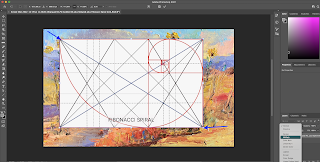
Dynamic Symmetry Overview Presentation by Karen Halbert
An Overview of Dynamic Symmetry as presented to the Rio Grande Art Association on Feb 21, 2026 in Albuquerque at the University of New Mexico. Quick Time Fast Show AND individual slides available here.
- Dynamic Symmetry Description
- Dynamic Symmetry Armature and Variations: Drawings by Artists
- Dynamic Symmetry in Practice
- Historic Paintings with Armatures
- Contemporary Paintings with Dynamic Symmetry Armatures
- Additional Topics.
Quick For Show For fast viewing.
Select image here to play:
Slides for scrolling:
(Images are low-resolution)


“.. Dynamic Symmetry. .. may be described briefly as the type of symmetry found in a natural organism, in the placing of leaves on a stem, in the architecture of the human body, always suggesting life and movement as opposed to static symmetry which suggests order without the potentiality of change. Mr. Hambidge and others working with him have found that the dynamic type of symmetry was used by the Greeks, who inherited it from the Egyptians and developed it in their art during the classic period with varying degrees of elaboration”—New York Times, Sunday, June 10, 1923 (as quoted In Dynamic Symmetry in Composition by Jay Hambidge pg 53)
Dynamic Symmetry can be viewed as a tool. Its versatility may suggest design possibilities that the artist might not otherwise consider. A composer is not hampered by knowledge of musical theory. An artist should not be hampered by knowledge of composition theories. Dynamic Symmetry makes more precise the aesthetic principle: a work of art must exhibit some kind of unity in variety.


Chimayo: 30.5x44. AR 1.443, close to a Root 2 (1.414...).
Chimayo was in a prominent position at the New Mexico Museum of Art, Aug 9, when I visited it; I was thrilled. I investigated a little and found that this was painted just before Bellows adapted Dynamic Symmetry. It does seem to utilize rebated squares. However, Bellows had not yet seen Hambidge’s lectures on Dynamic Symmetry. In fact, Bellows, was Hambidges’ star student beginning in 1918. As a trained carpenter it was natural perhaps for Bellows to incorporate proportional guidelines. Robert Henri invited Bellows to Santa Fe in 2017. Chimayo was painted during his stay. Please do go to the museum to see this Chimayo painting.
The placard as read in 2013: “Not all of the East Coast artists working in New Mexico found the southwest an ideal place to paint. George Bellows was known for his images of prizefighters reflecting the antagonisms of urban life. In the summer of 1917, he followed Robert Henri’s advice and came to New Mexico. But in New Mexico Bellows found the expansive spaces, rural scenes, and intense light difficult to paint, as is evident in Chimayó . The acidy light and awkward green vegetation reveals [sic] an accomplished artist wrestling with new and unfamiliar subject matter. The painting of the horse in the foreground underscores the difficulty he had with the local scene,”What do you think? The current placard is more complimentary.


Emil Bisttram, Metropolis, Sketch and Painting. The dynamic symmetry lines are quite visible. According to Art Historian, Traugott, How the West was One, NMMA. Bisttram used the principles of dynamic symmetry to structure works such as Kachina Series #. Bisttram “, drew, rather than measured, the divisions to prevent the understructure from becoming overly mechanical. ... The resulting drawing combines universal spirituality of the golden mean and dynamic symmetry with the culturally specific spirituality of the Pueblo kachinas.”.
From the Peyton Wright Gallery: “His development into abstraction was strongly influenced by Native American geometric designs and symbolism.”
“For Bisttram, dynamic symmetry .. guided him through the many stylistic experiments he undertook, and provided the essential coherency for his work as a whole.”
“Bisttram began by applying dynamic symmetry to representational compositions; after his move to Taos, New Mexico, in 1931, he began working with cubist and futurist styles, arriving at an aesthetic of pure geometric form by 1938, when he and nine others founded the Transcendental Painting Group.”
Bisttram lived in Taos from 1931 until his death in 1975. Throughout this period, he was an active Art Instructor.

Harry Nadler, King Chamber III. I’ve had fun reconstructing the diagrams. His lines use golden divisions rather than the dynamic symmetry armature. 38x62 =10x16.18... Many of Nadler's paintings are in a golden ratio. Nadler taught at the University of New Mexico for many years. See http://harrynadler.com/ for much more information. I very much enjoyed reading a review of Nadler by a noted Art Historian and Curator, Nicolai Cikovsky, Jr. from 2005. See the Reviews' tab on the website.
Traugott, The Art of New Mexico: How the West was One: “ Harry Nadler combined painterly applications of pigment with geometric structures in his paintings from the 1970s and 1980s. A strong proponent of rationality of compositions based on geometric divisions, Nadler often organized his paintings through the use of dynamic symmetry. He carefully subdivided compositions into components based on golden proportions and superimposed multiple grids to camouflage the highly organized geometric structure to his paintings. “


Michele Byrne, NM Museum of Art. Michele is known for her use of the Dynamic Symmetry Armature – an expanded one to include the Self-Similar Rectangles and Rebated Squares. Her Facebook posts frequently include steps where you can see pencil marks from the armature in the intermediate steps of her painting. Michele has been told by her followers that her compositions improved after she began using the Expanded Dynamic Symmetry Armature; she started winning even more awards.
She has a very informative article on Dynamic Symmetry that I highly recommend, available through the Oil Painters of America: https://www.oilpaintersofamerica.com/2022/03/dynamic-symmetry-and-how-i- incorporate-it-into-my-plein-air-and-studio-and-practice/


Paintings by Karen Halbert Selection from 2016-2025:
2016: Santa Fe River Turbulence, I was conscious of utilizing a "golden spiral" with a focal point at the golden mean. Fortunately, I had chosen a golden ratio for the panel: 10 x 16 (or as close as I could get to the golden ratio irrational number). I noticed that the rocks formed a kind of spiral, spiraling to that point and I took advantage of that. Comment by Judge, Jeff Legg: “I could live with this painting”.
2020: Blowin’ in the Wind: Remarks from the transcript of the Judge, Lynn Boyer: “Full of energy.. Engaging, vibrant, melodic. Swept around in it. Not just a painting of a tree. I feel the movement of the tree as the wind whips it around.
Unique painting.”
Tragically, Lynn passed away of a heart attack at a young age. The world is lessened by her absence.
2024: Turbulent Lands. Judge Donny Weber.
2024: Ghost Ranch Cabin. Judge Paul Murray,
2025: Abiquiu Cliffs Abstract, Judge Qiang Huang’s comments: "This painting is unique. The asymmetric color shapes are on top of a symmetric geometric pattern, showing a mathematical beauty."


Workshop Announcement: Aug 22,23 2026: