HIGHLIGHTS 2025 Aug Workshop Intuitive Composition and Dynamic Symmetry


This workshop was held at the Bluebird Studios in Santa Fe Aug 24, 2025.
Karen Halbert and internationally known, master artist, Albert HandelL, joined forces to provide the workshop. His intuitive composition skills were juxtaposed in this presentation with Dynamic Symmetry for a unique approach combining intuition and analysis.
The approach was demonstrated through the lens of dynamic symmetry with iconic, historic paintings along with Handell’s work.
In addition, hands-on guidance in the Dynamic Symmetry tool were provided.
Add a Dynamic Symmetry tool to your repertoire of painting tools: fast track your goal of good design and composition.
Halbert became a full-time artist after careers as a Professor of Mathematics, Computer Programmer and Wall Street Executive in NYC, leaving Manhattan for Woodstock, NY.
Halbert came across Intuitive Composition by Albert Handell in Woodstock. It inspired her to to move to Santa Fe in 2005!! She began to show work in galleries while studying with master artist, Albert Handell.
In a mentoring session early on, Albert encouraged Karen to include the topic of Dynamic Symmetry in her biography, taking advantage of her background in Mathematics. Recently she began to share its principles through teaching. This has resulted in workshops with Albert Handell on Composition and Dynamic Symmetry, sponsored by the Bluebird Studio of Santa Fe .
Albert’s paintings show a remarkable coincidence with the Dynamic Symmetry Armature. Is the theory behind dynamic symmetry natural so that intuition alone can give the artist design skills that incorporate the theory?
Albert's book, Intuitive Composition, might indicate an internalization of Dynamic Symmetry principles:
- “..composition is analyzed through the elements of shape, pattern, planes, positive/negative space and movement dynamics”.
- “Additional sections of the book include proportion”
Decide for yourself: does Albert subconsciously incorporate the Dynamic Symmetry theory? He did refer to the theory in Intuitive Composition as far back as 1988:


Dynamic Symmetry can be viewed as a tool. Its versatility may suggest design possibilities that the artist might not otherwise consider. A composer is not hampered by knowledge of musical theory. An artist should not be hampered by knowledge of composition theories. Dynamic Symmetry makes more precise the aesthetic principle: a work of art must exhibit some kind of unity in variety.

Dynamic Symmetry Armatures will be applied to iconic paintings to illustrate how the master artists might have composed their works.
By the way, as a hint at what's to come in today’s presentation, the golden PHI rectangle is the soul of Dynamic Symmetry. Its magic lies in how it’s the only rectangle that can be subdivided so that it consists of a square and another rectangle of the same proportion as the original one..


Note from Wikipedia about the spiral nature seen in the galaxy or in plants such as the sunflower:
“It is sometimes erroneously stated that spiral galaxies and nautilus shells get wider in the pattern of a golden spiral, and hence are related to both φ and the Fibonacci series. In truth, many mollusk shells including nautilus shells exhibit logarithmic spiral growth, but at a variety of angles usually distinctly different from that of the golden spiral."

“In 1923 Henri published The Art Spirit, a collection of essays and excerpts from letters, lectures and advice to students, embodying his philosophy of art. In the 1920s he experimented with the "Whirling Square" theories of Jay Hambidge, who devised a mathematical system of proportion applied to the placement of the subject on the canvas. Henri “spent several summers in Santa Fe, New Mexico, inspiring George Bellows to follow suit.”

From: Theo of Golden by Allen Levi:
"He pondered how a trunk could become so gnarled. It must have taken a great force to torque such a massive object. Or had some small force early in the tree’s life dictated its course of growth? You can bend a twig, but not a tree. Theo tried to imagine how an artist might draw this particular trunk. It has the look of a twisted towel. Or perhaps a human neck caught mid-scream, muscle and veins taut and protruding. Yes, the old oak is a permanent scream, a memorial to some horror it might have witnessed long ago. It would take a skilled artist to capture the soul of such a tree. Theo looked higher up at the branches. They too provoked questions. Was their symmetry achieved by design, the work of an arborist, or was it purely the result of nature? How did they find water in the midst of so much pavement?"


Page 36, Intuitive Composition. Negative Space. .”Try to analyze the negative and positive shapes. Start with the baseline of the adobe buildings on the left, which lead right into the baseline of the coyote fence on the right. Notice that this is practically a straight line. Focus on this area and consider all the buildings and trees above this line as one shape, one foreground mass, the positive areas. Consider the sky holes as constituting negative areas. Notice how the blue of the sky is broken up into different shapes—left, right, and beneath the dark rich green of the center tree. Squint and try to pull out these shapes. Abstract them and try to look only at these negative shapes to see what you come up with.”
The horizontals of the grid through the "eyes" align nicely with the fence line top and bottom.


Components of Dynamic Symmetry with its self-similar reciprocal rectangular sub-divisions of the panel as well as the square sub-divisions. I show this comparison here to indicate how I might have made decisions in this presentation for each painting. We will discuss each painting with this in mind. In this case would one grid suffice? If so, which one?
To use these grids for your own work, it may be premature to discuss how you might use these yet; I would like to show you examples first. But for preliminary thoughts: The artist can select the components and lines that might serve the composition best. I would suggest having a light tracing of a more limited grid in the field. In the studio, the artist might want to begin with a full grid as a plan/study and then along with a sketch of the scene to be painted, emphasize the lines that you want to use, erasing the others. You will see examples of plans used by master artists in selected ways, using the system a guide, but creatively.
Page 42, Intuitive Composition: ”Vertical movement visually relates to and follows the feel and pull of gravity.”. Vertical movement may need an offset of horizontals or diagonals, as in this painting.”

This workshop continued with some Iconic Paintings with Dynamic Symmetry grids overlaid on them by artists known to use the Theory. These paintings would have been constructed after 1917 when Hambidge began to teach his theory. Hambidge’s publications showed examples of Dynamic Symmetry sketches by George Bellows in the 1920’s, so I would say that he became the first famous user of the Theory. Parrish, the preeminent illustrator and painter later in the century, was very public about his use of Dynamic Symmetry, declaring that any painting not made with attention to the theory’s proportions would be “cock-eyed”. Bisttram and Higgins were very active artists in the art community of New Mexico and were dedicated to the practice of Dynamic Theory. Bisttram taught for many years in Taos and cofounded various art groups, including the Taos Art Group and later, the Transcendental Painting Group. He wanted to uncover universal truths about art and beauty through his artwork.
* Artists consciously used Rebated Squares well before 1917. Included here are examples of the use of Rebated Squares by Bellows, who also adopted Dynamic Symmetry for the rest of his short career (he died in 1925 of acute peritonitis).

In the Palisades, Bellows positioned the trunk on the left so that “the distance from it to the right edge is the same as the height of the painting – thus creating a square area to the right*”, a precise example of rebated squares. Many example of grids and measurements of Bellows’ works are available,.
*Michael Quick, The Paintings of George Bellows, pg 21.


Then we come to Maxfield Parrish, a well-known user of Dynamic Symmetry. Maxfield Parrish: “Dynamic Symmetry is a rediscovered rule of thumb, practiced by the ancient Greeks and the Egyptians before them, of laying out designs and compositions.
It is a very simple system with every division in a picture bearing a very definite relation to the rectangle as a whole.
As soon as you change the proportions of the rectangle, you knock the carefully thought-out design into a cocked hat.”


Victor Higgins, an artist who made his home in New Mexico, began to use Dynamic Symmetry early on and continued to promote it throughout his life. In an interview in 1932, Higgins stated: “The modern painter builds his picture; he does not merely paint it. He has his superstructure, his foundation, just as an architect has for his buildings.”

We see evidence of Bisttram’s Dynamic Symmetry use with this drawing from 1929 (pencil lines were enhanced here with white for clarity). Bisttram was a dedicated user of Dynamic Symmetry throughout his artistic life as the harmony and balance of the theory appealed to him.
*emil-bisttram.com.

Bisttram’s painting based on the sketch in the previous slide. I include Georgia’s Radiator Building here since I am intrigued by the similarities between it and Bisttram’s Metropolis.
Georgia O’Keeffe lived in Manhattan where she was undoubtedly introduced to Dynamic Symmetry in composition classes at the beginning of the Dynamic Symmetry “Excitement” in the 1920’s. So I applied a Dynamic Symmetry Armature to both works for further analysis. What do you think?
From the Peyton Wright Gallery: “His [Bisttram's] development into abstraction was strongly influenced by Native American geometric designs and symbolism.”
Bisttram lived in Taos from 1931 until his death in 1975.

The influence of Native American geometric designs and symbolism is evident in these two paintings. Note how the diagonal in the inner square on the right could be considered a Dynamic Symmetry (of the square). Bisttram was particularly devoted to exploring spirituality through art. Bisttram believed that art had the potential to lead an individual to a transcendental experience by speaking in “an esoteric language more easily felt than explained” (Wiggins 1988; 9). As written previously, Bisttram cofounded the Transcendental Painting Group, which later included many New Mexican Artists. I wish I had seen the major TPG Exhibit in Albuquerque held just a few years ago.
peytonrwight.com images but visit emil-bisttram.com for more information about this fascinating New Mexico artist. By the way he was a highly regarded educator as well, running schools of art in New Mexico, sharing his vision for other artists.

Let’s now look at paintings by Albert Handell with his intuitive approach. You will decide for yourselves if he’s been secretly incorporating Dynamic Symmetry in the design of his paintings. Recall that he did write in 1988 that he found the theory exciting.

Page 90. Intuitive Composition Proportional Relationship: “attention to proportional correctness and relationships is essential. ... In turn, the relationships of the parts relate proportionally to the whole”, You will see that this is a key concept of Dynamic Symmetry. Note how the horizontal lines through the “eyes” of the Dynamic Symmetry gird are close to the lines at the top of the rocks and the edge of the river. The main waterfall is just below the center in a nice kite shape with prominent rocks balancing it to the left and the right. The major rocks parallel a right reciprocal. I like the way the group of trees in the left foreground balances these rocks, with one tree mimicking the line of the opposite reciprocal line.

Intuitive Composition. Division of the Picture Plane. Pg 126.
The language in Intuitive Composition, indicates an affinity with Dynamic Symmetry, with its attention to proportions and divisions:
“Nearly all objects are understood through surface divisions made of lines or edges”
“Variety is achieved through horizontal, vertical or diagonal divisions and movements, etc. The central design elements .. may be placed in the center of the picture plane or to one side. Horizontals may be repeated by other horizontals or may be contrasted with verticals or diagonals that cut across whole or parts of areas. These divisions may be reinforced or contrasted by chains or rhythms of connecting or disconnecting directions; repetition or contrasts of shapes and movements; or tonal massing which adds to creating unity In the divided picture plane.
“No matter what the basic composition is, it is essential to remember the shapes and movements of the subject relate to one another and to the picture plane, creating the divisions of the picture plane. These divisions are subtleties of the composition and intrinsic to the painting’s carrying power.”

Pg 60, Intuitive Composition. Symmetry and Asymmetry. “The painting is divided practically In half..... by a tree nearly centered in the painting. It also touches and combines with the yellow building which ties up the right half section. There is then a feeling that the right half is cut into thirds. The tree in front of the building cuts the right side in half again. The entire area of the adobe building and the purple area just above it make up two squares equal in size. The symmetrical division in the right-hand position is made up of squares and linear divisions and has a boxlike feeling to it”...“As compared to the openness and spaciousness of the left side, the right side of the composition seems very geometrical. The sharp contrasts makes this painting both symmetrical and asymmetrical.” 20x24, AR – 1.2


Suerat was known to utilize geometry and to measure his canvases and the placement of his figures and trees carefully. Note how the figures are placed here along the edges of the rebated squares or marked by diagonals of the squares.
Seurat wrote “Art is harmony. Harmony is the analogy of contraries, the analogy of similars, [sic] in tone, shade, line, judged by the dominant and under the influence of a play of light in arrangements that are gay, light or sad. Contraries are..., as regards to line, those that form a right angle... Gaiety of line, lines above the horizontal; calm is the horizontal, sadness the downward directions”.
Perhaps Seurat had come close to his own dynamic symmetry theory - it seems to me.

Dynamic Symmetry: 30x40 3x4 Panel with Two Side by Side 1.5 DS . 6x8 has two 6x4’s This seems to be an ideal framework for a centralized painting within a 3x4 proportioned canvas.
I love how closely Georgia's painting aligns with a Side by Side Dynamic Symmetry Grid.


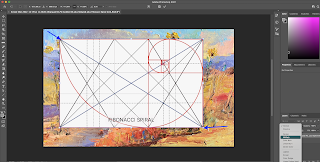
Animated GIF with images timed at 10 seconds apart. I moved a variety of armatures around on the square image (using layers in Photoshop) to align them with points and lines of the tree and its branches as much as possible.
You may right-click the GIF and save it to your computer. The resulting “gif” file is a combination of the different ”still” “jpg” images that you may view and print.